
Orux AI / Model notes
GPT Image 2.5 Sunburst: make a miniature bookshop read as a world inside a book
Read a saved bookshop illustration through its spine, page layers and interior scale; build a clearer brief for reading-event artwork.
On this page
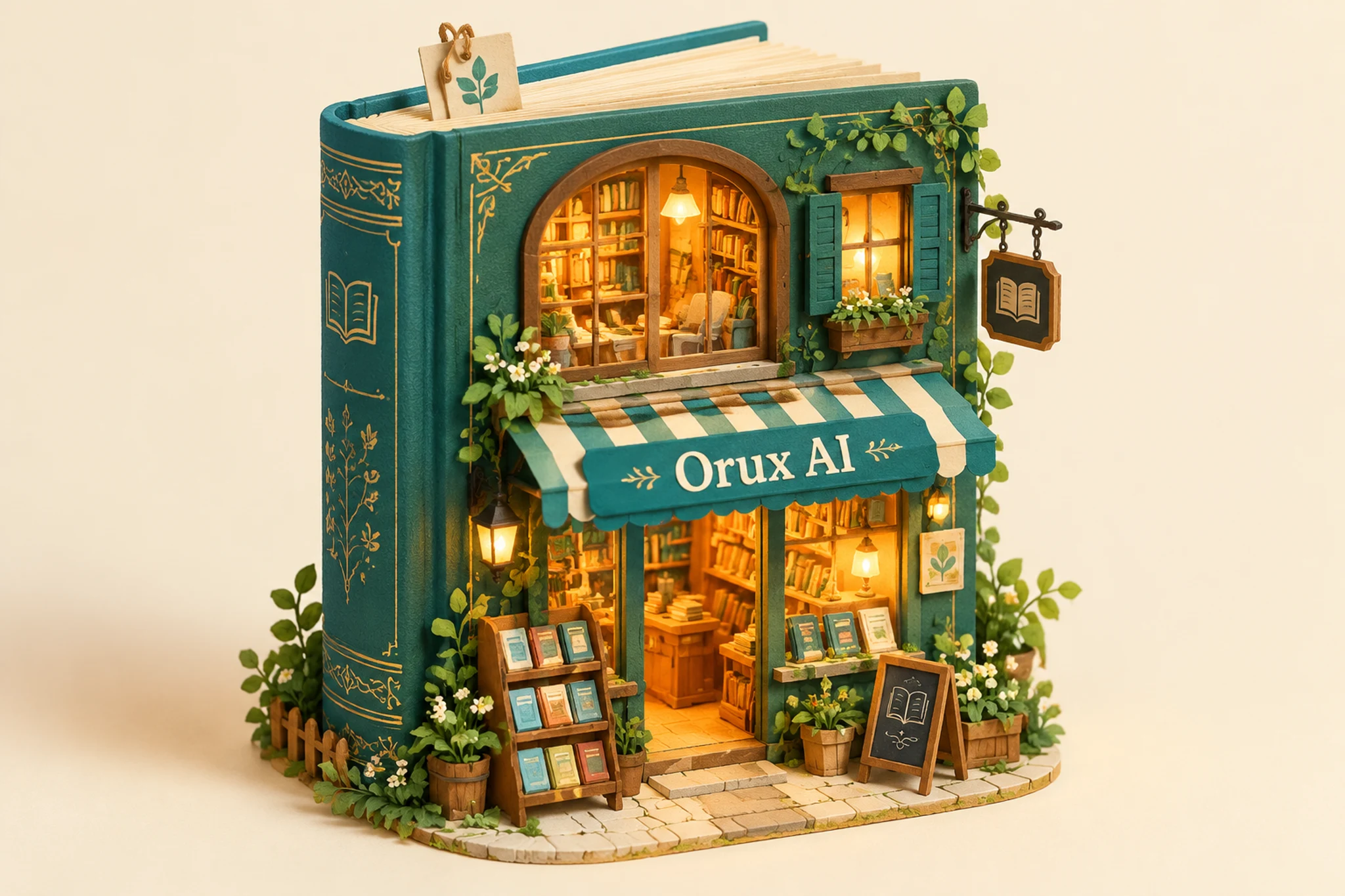
A reading-event illustration needs a visual idea people can recognize before reading the event details. In this saved GPT Image 2.5 Sunburst case, a large hardcover book becomes a tiny shop. The useful question is how the picture makes that impossible scale understandable.
Three clues that establish the miniature
The upright spine on the left still reads as a book, while the stacked pages above the shop act as a roof. The windows reveal much smaller shelves and lamps. Together, these give the viewer two scales at once: an ordinary book and an inhabitable building. The striped awning and plants connect the two rather than introducing a separate landscape.
Existing Orux model example, inspected for this article. This is an AI illustration, not a photograph of a real shop or a new generation for this article.
What the saved prompt asks for
The template records 2K and 3:2; the public file is 2048 × 1365. Those are the saved setting and observed file dimensions, not a promise about every output. The original instruction is:
A whimsical miniature bookshop built inside a giant teal hardcover book, glowing honey-colored windows, tiny green plants, detailed handcrafted paper diorama on a cream background. The front awning clearly reads exactly "Orux AI". Warm playful illustration, cinematic studio lighting, tactile paper textures.The instruction links the structure, material and lighting: a giant hardcover supplies the building, a paper diorama supplies tactile edges, and honey-colored windows suggest a welcoming interior. The visible awning reads “Orux AI” in this result. That observation does not establish a general guarantee of correct lettering.
Use the idea for reading-event artwork
For a library reading week or a book-club invitation, keep the giant-book construction as the central idea. Put the actual event name, date, accessible venue information and registration link into a separate layout after choosing the illustration. The generated brand lettering is part of this existing case; it is not a reason to treat a fictional shop as a real venue.
A materially different follow-up brief could ask for a mobile library inside an open atlas, using map folds as walls and a single entrance as the scale cue. This is a proposed direction, not an output demonstrated here. Change the spatial metaphor first; adding more decorative objects can make the story harder to read.
Review the visual story before adding details
| Check | Evidence to look for |
|---|---|
| Is the book still recognizable? | A readable spine, page edges and a coherent cover |
| Does the small world feel inhabited? | Shelves, a doorway and lights that agree in scale |
| Is the lettering usable? | Read every required character in the final artwork |
| Could someone mistake it for a real venue? | Label the image as conceptual AI artwork |
Swipe horizontally to view the full table.
Load the saved example on GPT Image 2.5 Sunburst and revise the scene around your reading activity. This case supports an analysis of one composition; it is not a comparison against other models or evidence that a revised prompt will succeed on the first attempt.
Model identity and the public example were checked on 2026-10-28. OpenAI model documentation describes the model; the visual observations above refer only to the linked Orux output.
Related articles
Browse all articles →
Seedream 5.0 Pro travel hero: crop a railway café without losing the story
Use an existing mountain railway café image to plan desktop and mobile crops, check signage and keep the scene readable.

Kling 4.0: How to Choose Between Two Videos from the Same Prompt
Compare two existing Kling 4.0 desk shots on Orux through composition, subject identity and motion continuity, with original videos, settings and prompt.
Qwen Image 3.0 Pro Poster Prompts: A Paper-Art Brand Example
Break down a real Qwen Image 3.0 Pro poster from Orux: title hierarchy, red-and-blue color choices, the original prompt and settings, and practical delivery checks.